
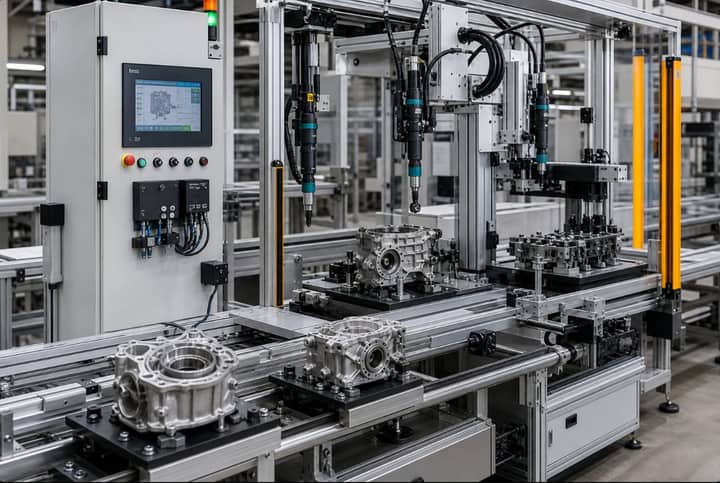
The Role of PLC and HMI in Stable Production Lines
Good automation is more than switching actuators on and off; it makes faults understandable and keeps production settings under control.
The PLC runs the machine logic, and the HMI is the operator interface. When both are designed well, faults are diagnosed faster and product changeovers happen with fewer mistakes. Good automation is not only about commanding motors, valves, or cylinders; it should make the machine state understandable and controllable.
Sensors, interlocks, alarms, manual commands, and automatic cycles need a clear structure. Fault logging and current-step display help production teams locate stoppage causes faster. When the operator knows which step stopped and which condition is missing, troubleshooting time drops noticeably.
A useful HMI should be simple, accurate, and aligned with daily operator work. Too much unnecessary information creates confusion, while missing important information leaves production teams dependent on guesswork and individual experience. Setting pages, alarms, I/O status, and manual commands should follow a clear structure.
One important use of PLC and HMI systems is managing product changes and production settings. If parameters such as speed, dwell time, pressure, temperature, or cycle count are stored in defined recipes, model changes become faster and less error-prone. This matters especially for lines that produce several products or sizes.
Automation works best when it is designed alongside mechanics, because even the best control program cannot fully compensate for weak fixtures, force transfer, or mechanical safety. A successful design considers mechanics, electrical systems, control logic, and operator needs together.